

Gran Canaria has long attracted people dreaming of living in a warm, year-round climate. However, many prospective property owners are asking themselves one of the most important questions: how much does it really cost to live in Gran Canaria?
The good news is that daily expenses don't have to be higher than in many major European cities. Of course, much depends on lifestyle, location, and whether you live in the center of Las Palmas , touristy Maspalomas , or quieter Arguineguín . In this article, we present the approximate cost of living in Gran Canaria in 2026.
Is living in Gran Canaria expensive?
There's no single answer to this question. For those coming solely for vacation, prices may seem high, especially in the most touristy towns. However, those living on the island year-round take advantage of local shops, markets, and services, so monthly expenses are often comparable to those in Poland or even lower than in many Western European cities.
The biggest difference lies in property prices and location. An apartment in Meloneras will cost significantly more than a similar property in Carrizal or Las Palmas de Gran Canaria.
Prices of apartments and real estate
Buying a Gran Canaria property is usually the biggest expense associated with moving to Gran Canaria.
Prices are influenced primarily by:
- location,
- distance from the ocean,
- view,
- building standard,
- access to swimming pool and infrastructure.
Approximate prices in 2026:
- studio apartment – from approximately EUR 120,000,
- one-bedroom apartment – from approximately EUR 180,000,
- two-bedroom apartment – from approximately EUR 250,000,
- houses and bungalows – from approximately EUR 350,000,
- luxury villas – from around €700,000.
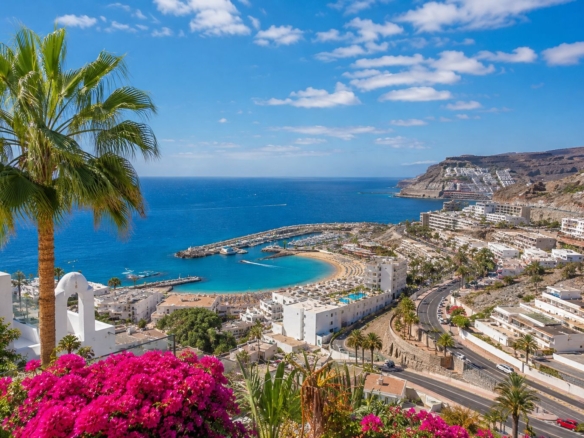
The most expensive locations are primarily Meloneras, Puerto de Mogán and selected parts of Maspalomas.
Property maintenance costs
After purchase, ongoing maintenance costs must be taken into account.
Most often they include:
- community fees,
- electricity,
- water,
- internet
- insurance,
- property tax.
Sample monthly costs:
- housing community – approximately 50–180 EUR,
- electricity – 40–120 EUR,
- water – 20–50 EUR,
- fiber optic internet – 25–40 EUR,
- mobile phone – from 10 EUR.
Community fees depend primarily on the standard of the complex. In buildings with multiple swimming pools, security, gardens, and a gym, fees will be higher than in smaller apartment buildings.
How much does groceries cost?
All the largest Spanish retail chains operate in Gran Canaria, including Mercadona, Lidl, Aldi, Carrefour, Hiperdino and Spar.
Sample prices:
- bread – 1,20–2 EUR,
- milk – about 1 EUR,
- eggs (12 pieces) – 2,50–4 EUR,
- yellow cheese (1 kg) – 10–16 EUR,
- chicken breast (1 kg) – 7–10 EUR,
- beef (1 kg) – 12–20 EUR,
- fish – from 8 EUR/kg,
- Canary Island bananas (1 kg) – 2–3 EUR,
- tomatoes – 2–4 EUR/kg,
- potatoes – about 2 EUR/kg,
- mineral water (1,5 l) – 0,50–1 EUR.
Local fruit, vegetables and fish are often of very good quality and available at attractive prices.
Prices in restaurants
Gran Canaria offers a huge selection of restaurants – from small family-run establishments to exclusive restaurants with ocean views.
Sample prices:
- coffee – 1,50–3 EUR,
- breakfast – 6–12 EUR,
- pizza – 10–16 EUR,
- lunch in a restaurant – 15–30 EUR,
- dinner for two – 40–80 EUR,
- local beer – 2–4 EUR,
- glass of wine – 3–6 EUR.
Outside the main resorts, prices are usually lower.
Transport
Gran Canaria has a well-developed bus network that connects most towns.
Example costs:
- bus ticket – approximately 1,50–5 EUR,
- fuel – approximately 1,20–1,50 EUR per liter (prices may vary),
- car rental – from around €25 per day in low season.
Many people living on the island choose to have their own car, especially if they live outside Las Palmas.
Healthcare
Spain has a well-developed healthcare system. European Union citizens can access public healthcare in accordance with applicable regulations, and many also choose private health insurance.
Private medical packages start from several dozen euros per month, and their scope depends on the chosen insurer.
Internet and remote work
Gran Canaria is very popular with people working remotely.
Fiber optic is available in most towns, and internet speeds allow for comfortable online work, video conferencing, and the use of cloud services.
The island also offers many coworking spaces, especially in Las Palmas de Gran Canaria.
Sample monthly budget
The cost of living depends on the number of people and lifestyle. For example:
One person
- grocery shopping – 250–400 EUR,
- utilities – 80–150 EUR,
- internet and telephone – 35–50 EUR,
- restaurants and entertainment – 150–300 EUR,
- transportation – 50–150 EUR.
To
- grocery shopping – 450–700 EUR,
- utilities – 120–200 EUR,
- internet and telephone – 50–70 EUR,
- restaurants – 250–500 EUR,
- transportation – 100–250 EUR.
The above costs include any loan or real estate purchase and community fees.
Is living in Gran Canaria cheaper than in Poland?
It depends on your way of life and where you live.
Local produce, fruit, vegetables, and fish often cost similar or less than in Poland. However, real estate in the most prestigious locations is significantly more expensive.
Compared to many Western European countries, the cost of living in Gran Canaria remains competitive, especially considering the climate and quality of life.
Is it worth living in Gran Canaria?
For many people the answer is a definite yes.
A mild climate all year round, the ocean, safety, developed infrastructure and a more relaxed pace of life have made Gran Canaria one of the most desirable places to live in Europe for years.
If you're considering buying an apartment, house, or villa, it's worth thoroughly researching the local real estate market and maintenance costs beforehand. This will help you plan your budget and choose the location that best suits your needs.
FAQ
How much money do you need to live in Gran Canaria?
One person leading a moderate lifestyle should expect monthly expenses of around €800–€1,300 (excluding real estate or mortgage costs).
Is food expensive in Gran Canaria?
Most basic groceries cost similar to, or slightly more than, Poland. Local fruit, vegetables, and fish are often very attractively priced.
How much does electricity cost in Gran Canaria?
Bills vary depending on usage and air conditioning. In a typical apartment, monthly bills typically range from €40 to €120.
Is it worth buying a property in Gran Canaria?
For many people, purchasing real estate means the opportunity to enjoy a unique climate all year round and invest capital in an attractive location.
Where is the cheapest place to live in Gran Canaria?
Typically, lower prices for real estate and everyday life can be found in less touristy towns, such as Carrizal or selected districts of Las Palmas de Gran Canaria, while the most prestigious locations – Meloneras or Puerto de Mogán – are among the most expensive.
Summary
The cost of living in Gran Canaria varies and depends primarily on the chosen location and lifestyle. However, for many people, the island offers a very favorable balance between quality of life and expenses. Its mild climate, modern infrastructure, and year-round ocean views make Gran Canaria one of the best places to live and invest in real estate in Spain.

Join the discussion